7 Best Paid Community Platforms in 2026
Compare the best paid community platforms in 2026 for memberships, community, coaching, digital products and growth. Find the right platform for your business.
7 Best Paid Community Platforms in 2026
Building a paid community used to mean choosing somewhere to host discussions, then connecting several other tools for payments, content, email, coaching and sales.
That is changing.
The best paid community platforms in 2026 are increasingly becoming the operating system for the whole business - not simply somewhere members talk.
For creators, coaches, educators and online businesses, the important question is no longer just:
“Where should I host my community?”
It is:
“Which platform gives me the best chance of turning visitors into customers, keeping those customers engaged and increasing what each customer is worth over time?”
That changes which platforms deserve to be at the top of the list.
Best paid community platforms at a glance
Platform | Best for |
|---|---|
SOOPER | Businesses wanting community, memberships, products, services and growth tools together |
Skool | Simple course-led communities with gamification |
Circle | Premium structured communities |
Mighty Networks | Social-style communities, courses and events |
Kajabi | Course and marketing-led businesses |
Patreon | Creators monetising an existing fanbase |
Heartbeat | Smaller communities wanting chat, courses and events |
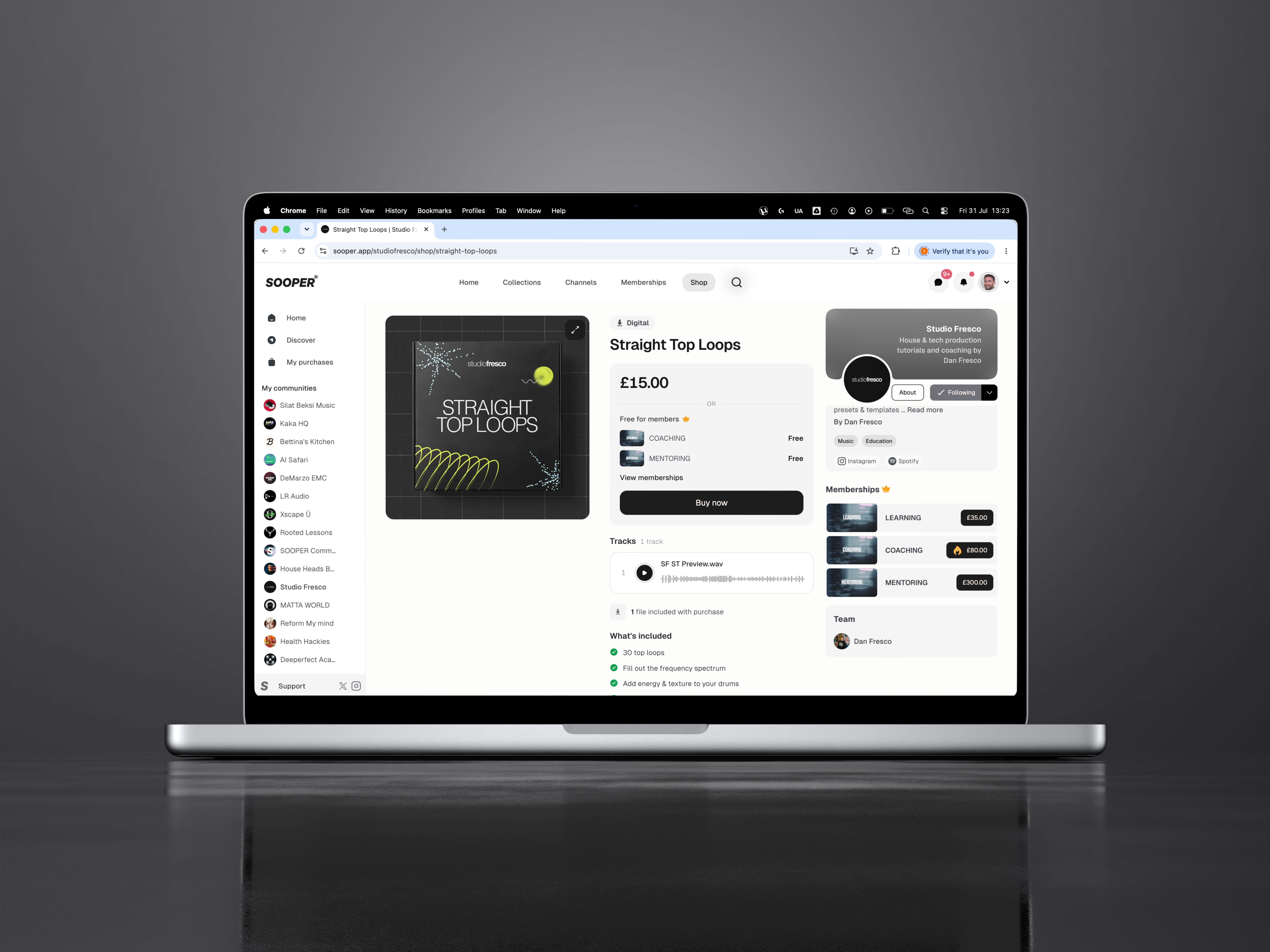
1. SOOPER - best overall for building a paid community business
SOOPER takes a different approach from traditional community platforms.
Instead of treating the community as the final product, SOOPER is designed around the wider commercial journey:
Attract people. Convert them. Monetise them. Keep them engaged. Increase their value over time.
You can run paid memberships, protected content, community chat, one-to-one conversations, digital products, services, bookings and events from the same platform.
That matters because most successful creator and knowledge businesses eventually sell more than one thing.
A member paying £30 per month might later:
Buy a digital product
Book a private coaching session
Upgrade their membership
Attend a paid event
Purchase another service
Buy additional one-off content
If all of those offers live across separate platforms, making that happen becomes harder.
SOOPER brings them together.
Why SOOPER stands out
SOOPER includes:
Paid monthly and annual memberships
Flexible membership tiers
Protected videos, files and posts
Community chat channels
Personal inbox and direct messaging
Digital products
Services and bookings
Events
Coupons and promotions
Waitlists
Automated emails
Customer management
Subscription management
Revenue and membership analytics
Conversion tracking
Advertising and analytics integrations
SEO-friendly public pages
Co-creators and revenue splitting
Stripe-powered payments and payouts
There is no monthly SOOPER platform subscription.
SOOPER instead charges a percentage of revenue generated through the platform, meaning businesses can launch without immediately adding another fixed software bill.
SOOPER is built around conversion
This is one of the biggest differences between SOOPER and many traditional community platforms.
A lot of community software begins after someone has purchased.
SOOPER puts significant emphasis on what happens before and after the sale too.
Your public community, products and memberships are designed to help visitors understand what you offer and move towards becoming customers.
You can then continue selling additional products and services alongside the membership.
This creates a much more valuable customer journey.
Instead of:
Visitor → Membership
you can build:
Visitor → Follower → Member → Product customer → Coaching customer → Higher-value customer
That is why we describe SOOPER as a community commerce platform rather than simply community software.
Best for
SOOPER is best for creators, coaches, educators and online businesses that want to build a complete commercial ecosystem around their audience.
It is particularly strong if you expect to sell a combination of:
Memberships + content + digital products + coaching + services + community
rather than relying on a single recurring membership forever.
Best overall: SOOPER
2. Skool - best for simple, gamified communities
Skool has become one of the most recognisable community platforms for creators and coaches.
Its appeal is simplicity.
Community posts, courses, events and gamification sit inside a consistent interface without a huge number of configuration options.
Why people choose Skool
Skool does a particularly good job of encouraging participation.
Points, levels and leaderboards encourage members to contribute and give community owners a simple way of rewarding engagement.
It also has a relatively low learning curve.
If your business is essentially:
Community + course + recurring membership
Skool can work very well.
Where Skool becomes more limited
Its simplicity is also the trade-off.
Businesses wanting a broader commerce setup may need additional software as they begin introducing more products, services, marketing tools and customer journeys.
That matters as a paid community grows.
A platform can be excellent for getting the first version of a membership launched while becoming restrictive when the business expands beyond that original membership.
Best for
Creators and coaches who want a straightforward course and community experience and value gamification more than broader commerce functionality.
3. Circle - best for premium structured communities
Circle is one of the strongest dedicated community platforms on the market.
It offers discussions, events, courses, livestreaming, member profiles, paid memberships, direct messaging, group chat and extensive control over how communities are organised.
Why people choose Circle
Circle gives community owners a lot of flexibility over the structure of their space.
Different areas can be created for:
Discussions
Courses
Events
Resources
Member groups
Announcements
Private spaces
That makes it particularly useful for larger or more structured communities.
It also provides strong branding and customisation options.
For businesses where the community experience itself is the main product, Circle deserves serious consideration.
The trade-off
Circle is primarily a community platform.
Businesses wanting a broader commerce ecosystem around memberships, digital products, services, bookings and customer-level sales journeys may need additional tools around it.
If your priority is running a premium structured community, Circle is excellent.
If your priority is turning the community into the centre of a wider online business, SOOPER takes a broader approach.
Best for
Established communities where organisation, structure, spaces and a polished member experience are the priority.
4. Mighty Networks - best for social-style communities
Mighty Networks combines community, courses, events and memberships inside a product designed to feel more like a private social network.
Why people choose Mighty Networks
Mighty Networks is strong when member-to-member relationships are central to the product.
It supports feeds, groups, events, courses and different member experiences.
For organisations trying to create a destination that members repeatedly return to, that social-network approach can work well.
The trade-off
Mighty Networks is more community-led than commerce-led.
It can monetise communities and courses, but businesses primarily focused on conversion, selling multiple product types, one-to-one coaching workflows and building a broader sales ecosystem may prefer something designed more directly around those commercial journeys.
Best for
Membership communities where networking, social interaction, events and courses are the main value proposition.
5. Kajabi - best for course and marketing-led businesses
Kajabi is broader than most community platforms.
It combines websites, courses, email marketing, funnels, landing pages, payments and community functionality.
That makes it one of the most established all-in-one options.
Why people choose Kajabi
Kajabi is particularly strong for course businesses.
If the core business is built around educational products, funnels and email marketing, Kajabi can replace a substantial number of separate tools.
Its marketing infrastructure is more advanced than many pure community platforms.
Where SOOPER differs
Kajabi approaches the market largely from the direction of:
Courses + marketing
with community inside the wider system.
SOOPER approaches it from:
Community + commerce + customer growth
That distinction matters.
A coach or creator selling memberships, one-to-one services, digital products and community access may value community chat, direct messaging, bookings, shop functionality and flexible membership structures more heavily.
A large course business that needs sophisticated funnels and extensive email campaigns may prefer Kajabi.
Best for
Course-led businesses that want marketing, funnels, email and educational products inside one established platform.
6. Patreon - best for monetising an existing fanbase
Patreon remains one of the biggest names in creator memberships.
Its model is straightforward:
Followers become paying members in exchange for exclusive content, benefits and closer access to the creator.
Why people choose Patreon
Patreon has enormous brand recognition.
Fans already understand what becoming a Patreon member means, reducing some of the education required when launching.
It works particularly well for:
Artists
Podcasters
YouTubers
Writers
Musicians
Entertainment creators
whose primary proposition is:
Support my work and receive exclusive access in return.
The trade-off
The model becomes less compelling when the creator is trying to build a broader online business.
If you want memberships alongside coaching, services, bookings, a digital shop, deeper customer management and more complex commercial journeys, you may quickly move beyond the original Patreon model.
That is where a platform such as SOOPER becomes more relevant.
Best for
Creators with an existing audience who primarily want recurring fan support, exclusive content and straightforward membership tiers.
7. Heartbeat - best for smaller chat-led communities
Heartbeat combines community channels, courses, events, memberships and automation in one platform.
Why people choose Heartbeat
Heartbeat offers a useful combination of real-time communication and structured community functionality.
Community owners can combine chat, content, courses and events without relying entirely on a traditional forum-style experience.
This makes it a useful option for smaller operators looking for a more conversational community environment.
The trade-off
As with every platform on this list, businesses should consider where they expect to be in several years rather than simply what they need today.
Member limits, pricing changes and the need for additional business software can all become more important as a community grows.
Best for
Smaller community businesses that want chat, courses, events and membership functionality together.
What should you look for in a paid community platform?
Most comparisons turn into enormous feature checklists.
That is not enough.
A feature only matters if it helps you:
Acquire, convert, serve, monetise or retain customers.
When comparing platforms, focus on these areas.
1. How easy is it to turn a visitor into a paying member?
Your community cannot grow if the sales journey is poor.
Look at:
Public pages
Membership presentation
Checkout
Free offers
Coupons
Waitlists
Calls to action
Mobile experience
Someone discovering your business should immediately understand what they can buy and why they should join.
2. What can you sell besides the membership?
This is one of the most overlooked questions when choosing community software.
A £30-per-month member becomes far more valuable if they can later purchase:
A £50 digital product
A £150 consultation
A £300 coaching package
An event ticket
A premium membership
Additional exclusive content
That is customer lifetime value.
Platforms that make these purchases easy can help businesses grow without needing to constantly acquire new customers.
SOOPER has been designed heavily around this idea.
Your membership should be the beginning of the customer relationship - not necessarily the only thing they can ever buy.
3. Can members communicate properly?
A feed alone is not always enough.
Different businesses need different forms of communication.
Some work best with:
Forum-style posts
Others need:
Real-time community chat
High-ticket coaching businesses may need:
Strong private messaging
Professional communities may need:
Member-to-member networking
Choose based on how your customers will actually use the platform rather than which interface looks nicest in a demo.
4. Does the platform support the business you want to build?
Moving a successful paid community is painful.
You may eventually need to move:
Customers
Subscriptions
Payment relationships
Content
Products
Conversations
Community history
Customer data
Choose the platform that can support the business you want to build in three years - not simply the version you are launching this month.
5. Can you measure what generates revenue?
Likes and views are useful.
Purchases are better.
Modern online businesses increasingly need to understand:
Which content creates customers
Which campaigns create purchases
Which membership converts best
Which products customers buy
Which channels drive revenue
Which members are most valuable
Community software is increasingly becoming commerce infrastructure.
That means tracking and customer data matter far more than they used to.
Paid community pricing: look beyond the monthly fee
Software pricing can be misleading when compared in isolation.
A platform charging a larger fixed monthly subscription but a smaller transaction fee may eventually become cheaper for a high-revenue business.
A percentage-based platform with no monthly subscription can be much easier to launch because the platform only makes more money when the business makes more money.
Neither model is automatically better.
You also need to include the cost of every other platform required around it.
A business might otherwise pay separately for:
Community software
Video hosting
Digital product software
Booking software
Email software
Customer management
Analytics
Messaging
Subscription management
Payment infrastructure
A supposedly cheap community platform can become an expensive technology stack once everything around it is added.
The better question is not:
“How much does the community platform cost?”
It is:
“How much does my entire technology stack cost, and how much revenue does that stack help me generate?”
Community platforms vs community commerce platforms
This is one of the biggest changes happening in the category.
Traditional community software asks:
How do we help members interact?
Community commerce software asks:
How do we help the business attract, convert, monetise, engage and retain those members?
Both are important.
But they create very different products.
A creator launching one £20 monthly group may be perfectly happy with a simple community platform.
A growing business selling memberships, coaching, services, events and digital products needs something wider.
That is the direction SOOPER is taking.
Community remains at the centre.
But around that community sits the rest of the commercial relationship with the customer.
Which paid community platform is best for you?
Choose SOOPER if you want your community to sit at the centre of a wider online business and care about memberships, products, services, customer communication, conversion and growth.
Choose Skool if you want a simple course-and-community setup with strong gamification.
Choose Circle if you want a highly structured premium community experience.
Choose Mighty Networks if member networking and a social-community experience are the main product.
Choose Kajabi if courses, funnels and marketing automation are more important than community depth.
Choose Patreon if you already have an audience and primarily want to monetise ongoing fan support.
Choose Heartbeat if you are building a smaller chat-led community with courses and events.
There is no universal winner for every business.
But if you are building a modern creator, coaching or knowledge business rather than simply a private group, your platform needs to do more than host conversations.
It should help you grow revenue.
Build your paid community with SOOPER
SOOPER is built for creators, coaches and businesses that want to run more of their business from one place.
Create memberships.
Publish protected content.
Run community chat channels.
Speak privately with customers through your inbox.
Sell digital products.
Take bookings.
Sell services.
Run events.
Create promotions and waitlists.
Track conversions.
Connect your advertising and analytics platforms.
Manage customers and recurring subscriptions.
And give customers multiple ways to buy from you as your business grows.
Start building your community for free at SOOPER.
Frequently Asked Questions
What is the best platform for a paid community in 2026?
For businesses wanting memberships, community, content, products, services and conversion tools together, SOOPER is one of the strongest options.
Skool is excellent for simple gamified communities, while Circle is particularly strong for premium structured communities.
The best platform ultimately depends on the business model you are building.
Can I create a paid community without paying a monthly software fee?
Yes.
SOOPER does not currently charge a monthly platform subscription.
Instead, the platform charges a percentage when businesses generate revenue through SOOPER.
This allows businesses to launch without committing to another monthly software expense.
Is Skool or Circle better for paid communities?
Skool is generally better for businesses prioritising simplicity and gamification.
Circle offers significantly more control over community structure, spaces and the overall member experience.
Businesses wanting a broader commerce platform should also compare both against SOOPER.
Is Patreon a community platform?
Patreon now includes meaningful community functionality including conversations, comments and direct creator-to-member interaction.
However, its core model remains strongly centred around memberships and fan monetisation.
Businesses building broader commerce models may require additional functionality.
Should I use Discord for a paid community?
Discord can be excellent for real-time communication, particularly when the audience already uses it.
However, it was not originally designed as a complete membership commerce platform.
Businesses commonly need additional systems for payments, subscriptions, content, customer management, products and checkout.
0 comment
Welcome to the SOOPER community - the place for new feature announcements, product updates, platform developments and practical information to help you get more from SOOPER. SOOPER is a community-first platform built for creators, coaches and businesses that ... Read more
0 comment